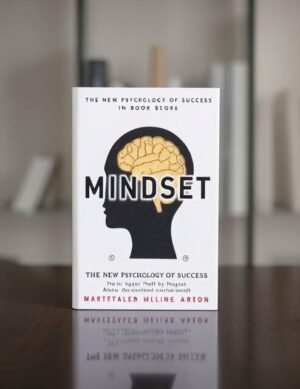
⚡️ The Mindset Revolution: Why Your Beliefs Matter More Than Talent
Stanford psychologist Carol Dweck spent decades studying why some people thrive through challenges while others plateau. Her groundbreaking discovery? Your mindset—not IQ or talent—is the ultimate predictor of success.
In Mindset: The New Psychology of Success, Dweck reveals how two core beliefs shape every aspect of our lives:
- 🔒 Fixed Mindset: “My abilities are carved in stone.”
- 🌱 Growth Mindset: “I can develop any skill with effort.”
“Becoming is better than being.”
– Carol Dweck
🔍 Fixed vs. Growth: The Psychology That Changes Everything
🔒 The Fixed Mindset Trap
- Believes intelligence/talent is static
- Avoids challenges to protect self-image
- Sees effort as pointless (“If I were smart, I wouldn’t need to try”)
- Ignores constructive criticism
- Feels threatened by others’ success
Real-world impact:
- Students cheat to hide their struggles
- CEOs ignore market changes to preserve their ego
- Athletes plateau early to avoid “looking untalented”
🌱 The Growth Mindset Advantage
- Believes abilities can be developed
- Embraces challenges as growth opportunities
- Sees effort as the path to mastery
- Learns from criticism
- Finds inspiration in others’ success
Proven outcomes:
- Underperforming students became top achievers
- Companies like Microsoft shifted culture to “learn-it-alls” > “know-it-alls”
- Michael Jordan trained obsessively after early failures
🧠 The Neuro-Science: How Mindsets Rewire Your Brain
Dweck’s research shows growth mindset physically changes your brain:
- MRI scans reveal more neural activity when learning from mistakes
- Embracing “yet” (“I haven’t mastered this… yet”) triggers dopamine-driven learning
- Challenges create new neural pathways, making you smarter
“In a growth mindset, failure is information—not identity.”
💥 Mindset in Action: Transforming 5 Life Arenas
1️⃣ Education
- Fixed: “I’m bad at math” → Avoids STEM
- Growth: “My math skills are improving daily” → Seeks harder problems
2️⃣ Business
- Fixed leaders (like Enron’s Skilling) hide flaws → Collapse
- Growth leaders (like Satya Nadella) normalise learning → Innovation
3️⃣ Relationships
- Fixed: “We’re soulmates; no work needed” → Crumbles under conflict
- Growth: “We choose to grow together” → Deepens through challenges
4️⃣ Parenting
- Praise intelligence (“You’re so smart!”) → Fear of failure
- Praise process (“Your strategy worked!”) → Resilience
5️⃣ Sports
- Fixed athletes (John McEnroe) blame losses on external factors
- Growth athletes (Michael Phelps) dissect failures to improve
🛠️ How to Build a Growth Mindset: Carol Dweck’s Toolkit
- Catch Fixed-Mindset Triggers
- Notice when you think: “I can’t do this” → Add “YET”
- Reframe Challenges
- Instead of “This might fail,” ask “What can I learn here?”
- Process Over Outcome
- Celebrate effort, strategy, and persistence—not just results
- The Power of “Vulnerable Listening”
- Seek criticism like a scientist seeking data
- Neuroplasticity Reminders
- Daily affirmations: “My brain grows stronger with every challenge”
📈 Case Study: Microsoft’s Mindset Revolution
When Satya Nadella became CEO, he distributed Mindset to all leaders. Results:
- Shifted culture from “know-it-all” to “learn-it-all”
- Revived innovation (Azure, Teams, OpenAI partnership)
- Market cap grew from $300B → $3T
“The learn-it-all does better than the know-it-all.”
– Satya Nadella
🔑 Key Takeaways: Rewrite Your Mental Operating System
- Your mindset is a choice, not a DNA sentence.
- Effort is the engine of genius. Mozart practised for 20 years before composing masterpieces.
- Failure is tuition paid for future success.
- Growth-minded people live richer lives—they marry better, earn more, and stay healthier (Dweck’s 20-year study).
“Why waste time proving how great you are, when you could be getting better?”
– Carol Dweck
💡 Final Insight: The Mindset Ripple Effect
Adopting a growth mindset doesn’t just transform you—it changes teams, families, and organisations. As Dweck proves:
- Teachers using growth language doubled student achievement
- Managers focusing on potential unlocked 65% more innovation
- Couples practising “process praise” reported 40% higher relationship satisfaction
Your beliefs don’t just predict your future, they create it.